There is still time for you personally, as a senior leader in any organization, to get ahead of the trajectory of sustainability. Still time for you, your teams, and your organization to be the one that policymakers, consumers, and your peers look to once the systems change we know will happen is truly underway. Use that time while it still exists. Before you fall into the group being pulled along by those who took the opportunity.
If only that opportunity wasn’t there
If only we were well on the way toward new sustainable systems for the environment, economy, and people. If only our old unsustainable systems were being remolded faster through a fair transition. But even if progress is currently too slow and too quiet, there is progress as research through HFS consistently shows:
- Investment, hiring, dealmaking, and decisions are still heading toward sustainability; the consulting, tech, and services sector is one example.
- In both data and qualitative conversations, the advantage of responsible business stands out.
- Transition plans are being disclosed, but regulation is required to catch up with leading businesses.
- Examples of positive sustainable tipping points are becoming clear, whether through cost, societal attitudes, or single events.
- Ukrainian businesses are showing how sustainability works even during an invasion.
- Telecom firms are finding their sphere of influence.
- Efficiency is driving (admittedly, we’re looking for a silver lining here) some level of decarbonization in the oil and gas sector.
- AI is finding a major sphere of influence despite being a significant local infrastructure challenge for energy and water and, globally, for material and worker rights.
The recent ‘Sustainability LIVE’ conference in London added further real-world examples
The penny has dropped—in data and in conversation—that sustainability is a strategic and a day-to-day benefit for most organizations:
- Energy efficiency, told through large utilities, engineering firms, and consumer choice platforms
- Well-thought-out resource use and healthier employees, community, and political (in some cases) relationships through a large UK dairy company, although it still has a way to go on its own transition plan
- Clear brand differentiation, seen across examples ranging from data platforms to global hotel chains
The industrial manufacturing sector is also beginning to connect its short-term efficiency push, broader immediate outcomes, and the long-term energy and sustainability transition. At HFS we’ll be exploring this brand new data set and series of enterprise examples soon.
If there was ever a time to differentiate on responsibility and resilience, it’s now
However, our research shows that finding professional, political, or financial support for sustainability is not as straightforward:
- The oil and gas industry, for instance, has concluded that clean energy doesn’t deliver margins it wants versus fossil fuels. This stands in contrast to global clean energy, which sees double the global investment—$2.2 trillion vs $1.1 trillion, predicted by the IEA, in 2025.
- Industrial waste volumes are an order of magnitude larger than municipal/consumer waste but go largely ignored.
- Supply chain teams are siloed from the richness of ESG data, covering what organizations must disclose across their environmental, social, and governance risk and impact.
- Political progress on mandatory transition planning for the largest companies and financial organizations governing systems is stalling in the EU and US. (although backtracking on regulation won’t necessarily halt progress). It is back on the table in the UK, already in place in Australia, Brazil, and New Zealand, and now part of the International Sustainability Standards Board (ISSB).
Regulation is moving in the direction of mandated transition planning despite turbulence
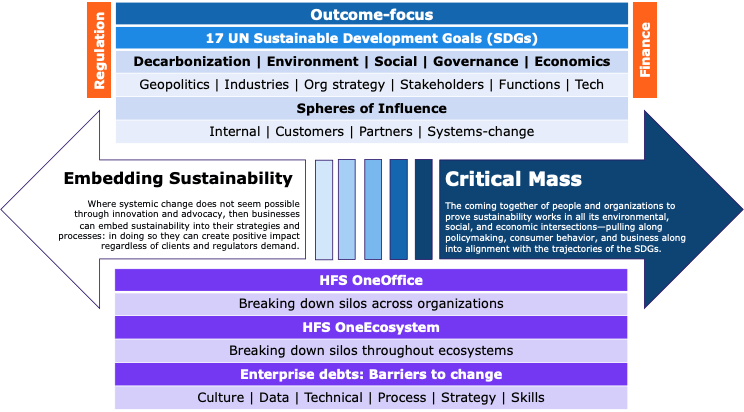
Using the data and analytics necessary for current levels of ESG reporting can help build those transition plans and for you to act on them, going way beyond compliance with the information you already have and the effort you already spent. Exhibit 1, our research framework for sustainability, encapsulates the spheres of influence for individuals, teams, and whole organizations.
The very least ESG data can do (and often must in law) is build materiality assessment to bridge short-term value and long-term strategic advantage.
Transition plans will also improve your financial sector relationships, fitting into the existing transition plans of banks, insurers, and all financial services firms. BFSI organizations might not be publicly disclosing transition plans, but they have them. And those plans will affect every sector that finance touches. Collaboration with their clients is currently “soft,” as one insider put it. But with the long-term mandate of BFSI versus most sectors, that collaboration will turn into red lines. We’ll be expanding on that soon after announcements from Deutsche Bank, ING, and other financial firms.
Exhibit 1: The HFS Research sustainability framework connects the global context, your most material spheres of influence, and the barriers and opportunities to change entire systems
Source: HFS Research, 2025
Your organization’s AI and technology plans are deeply connected with the opportunity to lead on sustainability
Sustainability and ESG teams are never overstaffed. And the promise of technology is growing, i.e., to take over the still highly manual data gathering and reporting and free up sustainability professionals to focus on what matters: impact.
Services-as-Software is the latest shift in that promise. AI, in combination with other technologies, plays its part in gathering data from across the enterprise, collating and analyzing it, and presenting it against the multitude of geographical regulations and voluntary disclosure standards (which change frequently).
With such tools, sustainability teams are not only free to focus on more impactful efforts but can leverage data, analysis, and baselining to identify their material spheres of influence and collaborate throughout their organizations to action impact.
There’s still time to lead on sustainability and be seen as part of the systems change already underway
The business case lies in connecting short-term action and long-term plans.
Transition planning and materiality assessments that identify clear spheres of influence, impact, and value are the best ways of connecting these dots, as well as finding funding from within your organization and from your financial backers and entire system of stakeholders.
Success for organizations and for sustainability will lie in connecting the short-term efficiency push that global turbulence demands, with the long-term trajectory of sustainability that most agree is necessary and will happen.
The exact timeline of this systems change remains unclear. We do know what outcomes and timelines we need to meet.
And the time for YOU as a leader, for yourself, your teams, and your organization and industry, to be a part of that change, and not a follower, keeps running out
Use that time to find a new, positive impact.
 criticalmass-sustainability.com
Leave a comment