Two things must happen in 2026 to accelerate the move away from GDP and growth-at-all-costs toward judging society based on what actually matters for people and the environment.
- Clarity on the end point and principles of new economics: which we have, in so many different forms like Doughnut Economics, Missions, SDGs, GEP, and countless other frameworks, metrics, and philosophies going beyond GDP. We need to align. The promising UN High Level Expert Group on Beyond GDP is working on this right now. Contribute any expertise and ideas you can.
- A transition plan for new economics: How do we unpick the current system from inside the current system? A step-by-step path from now to that end point. With core principles that allow continuous improvement even after the economy is measured differently. An approach that wins the political conversation, as well as proving that new economics can work for people and the environment, as well as working within the current system.
The world is not working well enough for enough people
For all the commentary that different indicators show progress over the years and decades (and many do) it’s not good enough. We can’t possibly think it’s good enough when we’re hitting irreversible tipping points across climate and nature, wealth concentration and inequality is rising, and 50 million people, including 12.5 million children, are in forms of slavery worldwide.
History suggests that societal collapse happens after inequality reaches a point where a trigger event brings it all down, brilliantly outlined in Goliath’s Curse by Luke Kemp. Everything from the financial crisis of 2007-2008 through to Brexit and Donald Trump’s first election, and now to his globally destabilizing attack on Venezuela, suggests we may not be far off collapse. Facing either global war or a new age of imperialism where the Americas, Europe, and Asia are carved up.
It doesn’t have to be like this. It can be better
We can create a system where people have a platform to live their best lives. Not a “safety net” that traps people in poverty. A fair society that works especially for the least advantaged. Real equality of opportunity. Not only in law but in genuine opportunity across health, education, housing, politics, and beyond.
Some use the phrase “ideas whose time have come.” But Universal Basic Income (UBI), proper worker representation in companies, and environmental protection have historically found champions across the political spectrum. Daniel Chandler makes the case exceptionally well in Free and Equal. And the first few chapters of Rutger Bregman’s Utopia for Realists does the same AND reminds us that Richard Nixon was a major advocate of UBI! Until the lobbyists got to him. Seriously.
A better system for people and the planet needs to define economies and success in new ways. To get there we need a transition plan. From now to that new economy. A transition plan that can prove that these new economy principles and policies also work across economic, social, and environmental factors. Showing the interplay between new and old economics, and the incentive for a transition. A critical mass that triggers positive tipping points to bring policy, consumer behaviour, and business along.
That critical mass is building. And it’s becoming increasingly clear, including at COP30, that you’ll either be a part of it, or pulled along. The energy transition is moving at pace, transcending politics, whether through the economics of renewable power, electric mobility, or industrial investment; see these primers from RMI and HFS Research for 2026. The financial sector is moving its transition plans toward redlines, not just soft collaboration, although not fast enough. We explore more past and future tipping points here.
The science for moving beyond GDP is clear. Time to get the communication and roadmap right
There are so many frameworks, so much science, countless metrics, and millennia of philosophy. They need to be assembled into a more globally-recognized end point for measuring “good.” A transition plan must then outline the principles and concrete steps to get there, adaptable enough to be tailored to each region, country, and local authority. The “end point” must be somewhere we can then continuously improve on, once we’re measuring success in better ways than GDP growth.
The UN High-Level Expert Group on Beyond GDP is trying to do the first part in defining a new global framework, in what seems like a potential evolution of the Sustainable Development Goals (SDGs). I hope it will also tackle the transition plan.
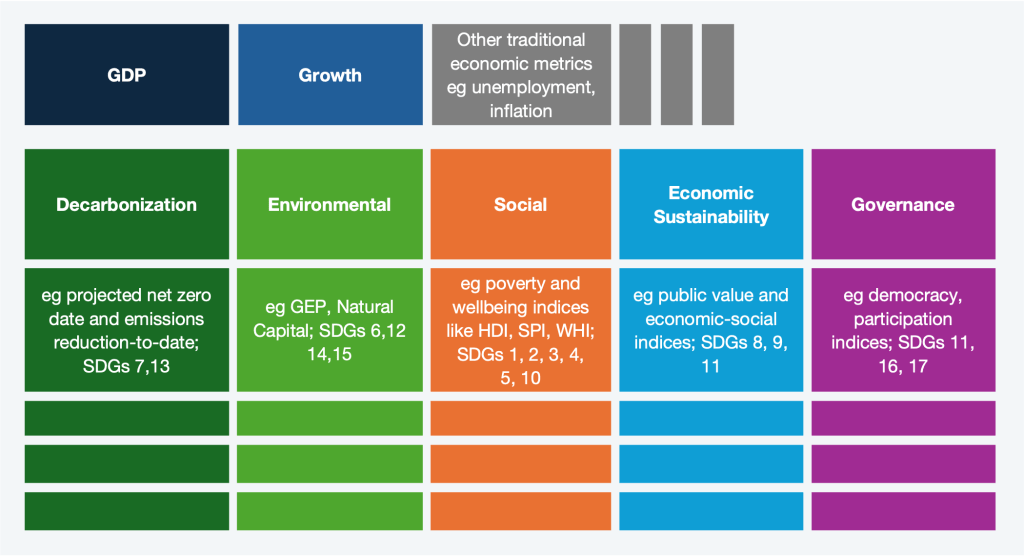
This 2025 report from my time at HFS Research (see graphic above) explores a selection of frameworks, metrics, and concepts to shape the new economy. As a summary:
- Doughnut Economics: maximizing wellbeing above a “social foundation” while staying within planetary boundaries.
- Mission Economics: aligning public, private, and civil society toward goals, reminiscent of the Moonshot.
- GEP and AGE: Gross Environmental Product, which has been adopted by states in Northern India, and the Alliance for Global Environment which aims to expand though the UK, US, Norway, Ireland, and beyond (and which much of the Critical Mass ecosystem is involved in).
- Sustainable Development Goals (SDGs): We’ve missed most all of the SDG targets leading up to 2030. But now is a chance for an ambitious reset which may come from the UN Group on Beyond GDP.
- Other metrics: World Happiness Index, Gini Coefficient for inequality, Natural Capital, Public Value Index, and so many more.
- Principles: such as the philosophy of a fair society being one where you’d be happy not knowing who you were in it, John Rawls’s Veil of Ignorance. Rawls also covers the platform, fairness, and equality commented on above.
A transition plan to that new economics must then:
- Start the conversation: get the communication right, and win the argument by adding new metrics alongside GDP, growth, and other traditional economic numbers. Refer again to this 2025 report and graphic above.
- Define the vision and tell the story: based on that outline of new and old economics and how they interplay. We’ll see what the UN Group comes up with. There’s so much more to draw from above.
- Outline the transition step by step: keep coming back to the roadmap and progress. With concrete actions, plans, and policy. Both what is working in the current system, and what needs further progress and broader systemic change.
What can most of us do?
Many of our spheres of influence will include contributing to the UN Group.
Those in political and policy circles can lobby positively. As can those with senior positions in business, NGOs, civil society, and beyond. You might not be able to access Parliament, but there’s new economy momentum at all levels of government. See the progress the Doughnut Economy Action Lab (DEAL) is making in Amsterdam, London, and across the world.
You can partner with universities and other groups aiming for new economy goals. Most every university has some presence in this field. Just be sure that when you’re having conversations, focus on “what are we actually going to do and make happen.”
Define yourself beyond GDP and traditional economics as much as you can within the system and your sphere of influence: your personal circles, as an individual, team, or whole organization.
New economics desperately needs a transition plan. You can piece part of it together.
 criticalmass-sustainability.com
Leave a comment