New economics needs a transition plan. It needs clarity on its end point. It needs far more emphasis on the “how” of systems change.
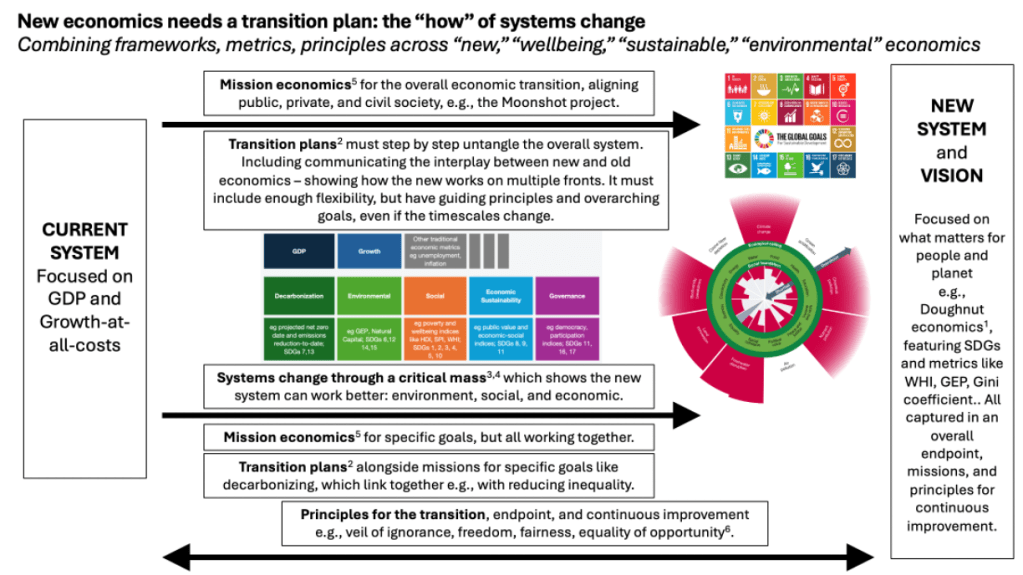
This “working graphic” and article combines thoughts on a new economics framework: across a selection of existing frameworks, metrics, principles across “new,” “wellbeing,” “sustainable,” “environmental” economics – with transition planning and systems change incorporated.
When I first got involved in sustainability professionally and politically, I used roadmapping as a gauge of what was legit, and what was questionable. I still do.
Is there a clear picture of what we’re aiming for? Is there clarity on where we are now? Is there a plan from here to there? Also called a transition plan…
Economics also needs this transition planning approach.
Whichever definitions and terminology you use, “economics” is intertwined with “sustainability” in so many ways.
From a current system focused on GDP and growth-at-all-costs, this graphic is a first pass sketch linking the old and new, with emphasis on the transition planning and systems change needed – as well as the principles governing that transition, end point, and continuous improvement should we reach a society and economics judged on better metrics for people and the planet.
This new system has many potential framings. The UN High Level Expert Group on Beyond GDP is currently aiming to bring the wealth of existing frameworks, metrics, science, and principles together into clarity for what a new economy might look like. Its interim report is encouraging. Its final report could feature a range of extracts from, for example, Doughnut Economics1, which itself features many elements of the UN Sustainable Development Goals (SDGs) and other metrics like World Happiness Index, Gross Environmental Product (GEP)7, the Gini Coefficient for inequality.
A transition plan2 must step by step untangle the overall system and include clear ways of communicating7 the interplay between new and old economics – showing how the new works on multiple fronts to build momentum into the transition and systems change.
The transition plans must sit alongside alongside missions for specific goals like decarbonizing, which link with goals like reducing inequality.
Systems change can be accelerated through a critical mass3, 4 which shows the new system can work better on multiple fronts.
As a starting point, a range of metrics can be brought alongside GDP and growth as a means of getting the communication right7. Showing the interplay between these metrics. Proving the case for new guiding principles and a new economic system.
Mission economics5 can find a role in the transition – aligning the public and private sectors, as well as civil society, toward clear goals – whether for the overall system or specific goals… like the Moonshot project as an example.
Principles for the transition2,6, its endpoint, and continuous improvement must also be clear. We can consider, for instance, the “veil of ignorance” where a society can be considered fair if you’d be happy not knowing who you were within it… as well as overarching beacons like giving everyone the freedom to live their best life on top of a strong platform (not a “safety net”), in a fair society that works especially for the least advantaged, and real equality of opportunity across health, environment, housing, democracy, work, and much more.
Over the coming months we’ll continue to refine the graphic and overarching narrative, feeding it into different professional and political conversations.
Do reach out with any and all thoughts, questions, and ideas for collaboration and development!
References
1. On Doughnut Economics: https://www.nature.com/articles/s41586-025-09385-1
2. On transition planning for new economics: https://criticalmass-sustainability.com/2026/01/13/new-economics-desperately-needs-a-transition-plan/
3. On critical mass: https://criticalmass-sustainability.com/2024/05/18/founding-statement-critical-mass-for-sustainability/
4. On systems change: https://www.hfsresearch.com/research/systems-futureproof-sustainability/
5. On Missions: https://marianamazzucato.com/books/mission-economy/
 criticalmass-sustainability.com
Leave a comment