The economy is not working for too many people. And too few people in positions of power truly realise just how deep that failing goes. The economy should not be a scoreboard. It’s about people. It is the way we provide for each other.
But the question is not just what a new economy looks like, but how we unpick the old one and move forward. This article aims to outline the beginning of a plan towards a Wellbeing Economy for the UK.
For too long, British politics has treated the economy as an end in itself. Totally lacking in vision or plan. Growth is reported, markets react, ministers congratulate (or excuse) themselves – but millions of people still feel less secure, less healthy, and less in control of their lives.
The next stage of economics must be a transition to a wellbeing economy: one judged not only by GDP, but by whether people can access care, find fulfilling and secure work, live in a thriving environment, affording a decent home, breathe clean air… all on a liveable planet, which is beyond essential for any level of freedom and wellbeing.
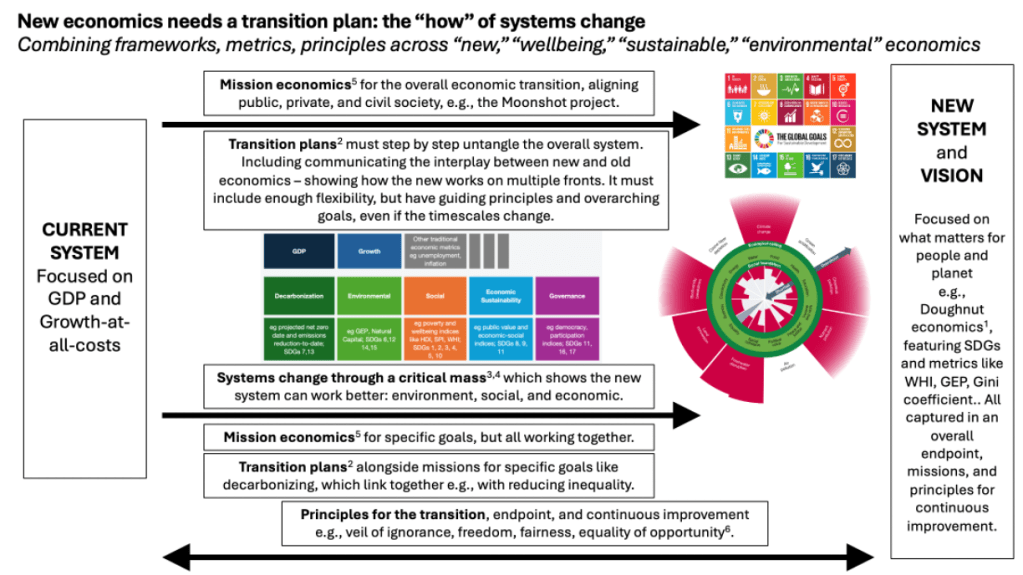
But that new economy needs more than a vision and destination. It needs a plan: a practical route from the current, complex, globally connected system to a better one, built from inside the institutions, incentives, and fiscal realities we have now.
Here are seven steps that begin to shape a wellbeing economy in the UK. That plan will ultimately lead to a wellbeing economy bill. These steps build on previous articles connecting new economics, systems change, and transition planning – the latest of which you can find here.
1. Change what government measures
A set of national wellbeing indicators must sit alongside traditional economic measures like GDP, inflation, and employment in budgets, spending reviews, and broader policymaking. The UN High-Level Expert Group on Beyond GDP is close to publishing its version of that dashboard.
If we want different outcomes, we must define and measure them. That means our political conversation must centre around more than undefined growth.
Health, child poverty, housing security, carbon emissions, access to nature, unpaid care, regional inequality, democratic participation, and so much more should be published and, crucially, communicated by government as core tests of success, not appendices.
This can also be framed in terms of wealth. The wealth of nature, society, and our communities. Also referred to as Natural, Human, and Produced Capital (the latter being a form of GDP, captured in terms of “wealth” rather than a “flow”).
2. A national wellbeing mission created with people, not for them
A wellbeing economy cannot only be technocratic. It must be co-created with communities, local government, business, trade unions, and all parts of society.
The Wellbeing Economy Alliance Policy Design Guide stresses meaningful participation; the New Economies for Eradicating Poverty (NEEP) Roadmap includes deeply democratic planning.
A form of UK Wellbeing Economy Commission, alongside citizens’ assemblies in every nation and region, can define what prosperity means in different places and how policy should reflect it. That is not an optional add-on. It is how liberal, democratic change becomes durable.
That engagement cannot be a one off either. Genuine devolution and local democracy – for example, ward assemblies, often scrapped as cost-saving measures, and councils accessible to all – must be protected as a form of continuous engagement and improvement.
3. Back what grows wellbeing and phase down what damages it
A wellbeing economy is not anti-business. It is pro-value creation for all and for the environment. The state should actively grow the sectors that help us all achieve a sustainable future: clean and affordable energy, retrofitting homes and lowering bills, accessible care for all as close to home as possible, public and preventative health, education and genuine equality of opportunity, public transport as a better option rather than a forced move away from cars, nature restoration and thriving local environments, social housing and tight-knit local high streets.
The state should transition FAIRLY away from and stop subsidising the activities that extract wealth, pollute communities, and deepen insecurity. The combination of state subsidy for fossil fuels and the ongoing turbulence in global energy markets is only one example of the insecurity that oil and gas brings when the alternatives are proven – and we have all the levers to meet the challenges of the transition.
We must grow what sustains life and helps people thrive. We must shrink what does not fairly. Public procurement, regulation, and industrial strategy should all follow that rule.
4. Start with security
People cannot embrace change if it feels like loss. The platform for a transition to a wellbeing economy must therefore be economic security: a strong social platform and protection (not merely a safety net), universal basic services, better childcare, fair housing, decent sick pay, and a serious anti-poverty strategy. The natural extension of that transition leads to a Universal Basic Income (UBI) – a true platform for everyone to thrive – but we’ll cover that in the future.
The transition has to begin by making everyday life more secure, with in itself would unleash immediate benefits to the economy, mental health, and so much more.
Security for all needs us to address inequalities of wealth, power, and political voice. When Paul Marshall or Elon Musk can buy up massive communication platforms it dampens the effectiveness of, say, capping donations to political parties or moving to a proportional voting system.
That extreme inequality is a threat to democracy in of itself. I’ve referenced Goliath’s Curse by Luke Kemp in past articles, which outlines how history suggests that societal collapse happens after inequality reaches a point where a trigger event brings it all down. Everything from the financial crisis of 2007-2008 through to Brexit and Donald Trump’s first election, and now to his globally destabilizing attacks on Venezuela and Iran, suggests we may not be far off collapse. Facing either global war or a new age of imperialism where the Americas, Europe, and Asia are split up.
5. Pay for the transition fairly
The fastest way to kill a new economic settlement is to imply that ordinary families must foot the bill.
But we can meet the challenge of being responsible AND FAIR with public finances while going further on systematically reforming and redesigning the tax system.
Tax Justice UK shows there is substantial room to simplify our extremely convoluted tax system, for example examining the 1200 tax reliefs. Of those, 240 “non-structural” reliefs cost £214bn – more than 7% of GDP and more than we spend on the NHS in England. Rishi Sunak is a perfect example that shows how our tax system isn’t progressive – he paid a 23% tax rate on his £2.2m earnings in 2023. And if we compare the Sunday Times Tax List with the Sunday Times Rich list, there’s very few people on both.
That simplification comes before we even start talking about taxing wealth and unproductive rent-seeking more fairly through, for example, a tax on assets above £10 million, proper capital gains reform, closing carried-interest loopholes, extending National Insurance to investment income, stronger HMRC enforcement and tougher action on multinational profit shifting, and reforming council tax and business rates, possibly into a land value tax.
This is not just about revenue. It is about rewiring incentives away from extraction and towards contribution and a thriving economy for everyone.
6. Devolve power so transition happens where people live
National missions matter, but the wellbeing economy will be built in towns, cities, counties and nations.
Wellbeing economics champions fiscal devolution, community wealth building, local banking, participatory budgeting and powers for councils and mayors to align transport, housing, skills, and health around local wellbeing.
Power should be shifted out of Westminster and Whitehall to as close to people as possible for each particular policy area. A wellbeing transition is one of the strongest practical arguments for doing so.
7. Build critical mass
Systems do not change all at once. But they can tip suddenly, even when the opportunity for change seems lost. There are many historical examples including the fight equal marriage. A current example is the overwhelming economics of renewable solar and wind energy meaning the energy transition is happening at pace (but still with a need to accelerate and address gaps in grids and energy storage) despite the most vindictive politics. The International Energy Agency (IEA) reported $2.2 trillion of investment last year into clean energy versus $1.1 trillion into fossil fuels.
Creating a wellbeing economy must create a critical mass of both objective evidence as well as public and political consciousness.
That critical mass will prove the new approach to the economy works in practice and bring business, consumers, and institutions with it.
The plan should begin with visible wins and clear communication, embedded in narratives and policy: warmer homes, lower bills, shorter NHS waits, better buses, thriving town centres, cleaner rivers, stronger local economies.
Add these new metrics beside old ones. Show that wellbeing economics can outperform the status quo on the things people care about most. Then lock it in through institutions, budgets, and public expectation.
This is only the beginning of a plan
We will need to expand on and cost the measures in this article. We will need politicians and parties of all colours to engage and create Wellbeing manifestos and draft legislation. We will need powerful answers to questions like, “what about the bond markets?”
The task now is to redefine growth for the wellbeing of people and the environment, distribute its gains more fairly, and refuse to count success in ways that ignore whether life is actually getting better.
A wellbeing economy is not a leap into the unknown. It is a step-by-step transition: measure better, govern differently, invest in what matters, protect people through change, tax wealth fairly, devolve power, and build the critical mass for a new common sense.
That is system change from within the system.
 criticalmass-sustainability.com
Leave a comment